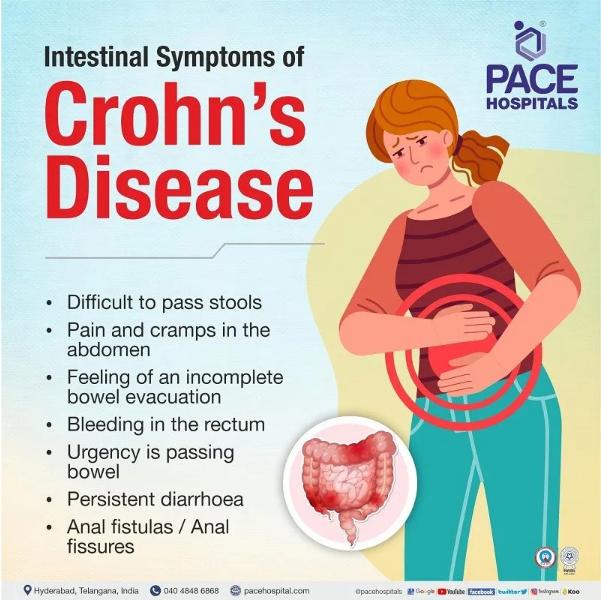

Julian Knight was clinically diagnosed with Crohn’s Disease early on whilst incarcerated in H.M. Prison Barwon. This is a bowel related disease.
[In Julian Knight’s own words]:
“In March 1995, I contracted Crohn’s disease, a chronic and incurable inflammation of the digestive tract. During 1995-2010, I suffered from various acute periods of the disease flaring up. My condition was not stabilized until March 2010. If I had been still serving [in The Army] in March 1995, I would probably have been relegated to the Reserve List of Officers or been transferred to the Active Army Reserve.”
Despite specialist medical treatment for this condition and he consistently following specialist-referred dietary advice, his medical condition perpetuates.
We supply some online explanatory links to provide expert information generally about Crohns Disease, not that specifically inflicting Julian Knight. We are unaware of the causes of this chronic medical condition. In Julian’s case, this disease might well be generic, else caused due to the very poor Victorian* prison food and diet regime.
Crohn’s Disease?
Crohn’s disease is a chronic inflammatory bowel disease (IBD) that causes inflammation anywhere in the digestive tract, leading to symptoms like abdominal pain, diarrhea, fatigue, and weight loss. It is thought to be caused by a combination of genetic, immune, and environmental factors. While there is no cure, treatments focus on managing symptoms through medications, surgery, and nutrition, with the goal of inducing remission.
Overview of what is Crohn’s disease?
(A Mayo Clinic expert, Gastroenterologist William Faubion, M.D. explains)
Crohn’s disease is a type of inflammatory bowel disease (IBD) that causes swelling and irritation of the tissues, called inflammation, in the digestive tract. This can lead to belly pain, severe diarrhea, fatigue, weight loss and malnutrition. Inflammation caused by Crohn’s disease can affect different areas of the digestive tract in different people. Crohn’s most commonly affects the end of the small intestine and the beginning of the large intestine. The inflammation often spreads into the deeper layers of the bowel.
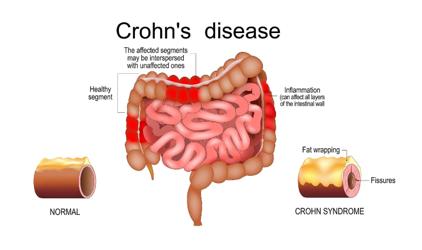
Crohn’s disease can be both painful and debilitating. Sometimes, it may lead to serious or life-threatening complications. There’s no known cure for Crohn’s disease, but therapies can greatly reduce its symptoms and even bring about long-term remission and healing of inflammation. With treatment, many people with Crohn’s disease can function well.
Symptoms of Crohn’s disease typically include:
- Diarrhea
- Fever
- Fatigue
- Belly pain and cramping
- Blood in the stool
- Mouth sores
- Reduced appetite and weight loss
- Pain or drainage near or around the anus due to inflammation from a tunnel into the skin, called a fistula.
Crohn’s disease can affect any part of the small or large intestine. It may involve multiple segments, or it may be continuous. It most commonly involves the last part of the small intestine. In some people, the disease is only in the colon or the large intestine. Symptoms of Crohn’s disease can range from mild to severe. They usually develop gradually, but sometimes might come on suddenly, without warning. Someone with Crohn’s disease also may have periods of time with no symptoms. This is known as remission.
People with severe Crohn’s disease also may experience symptoms outside of the intestinal tract, including:
- Inflammation of skin, eyes and joints
- Inflammation of the liver or bile ducts
- Kidney stones
- Iron deficiency, called anemia
- Delayed growth or sexual development, in children.
When to see a doctor:
See a healthcare professional if you have ongoing changes in your bowel habits or if you have any symptoms of Crohn’s disease, such as:
- Belly pain
- Blood in the stool
- Nausea and vomiting
- Diarrhea lasting more than two weeks
- Losing weight without trying
- Fever in addition to any of the above symptoms.
In October 2005, Julian experienced another seriously painful ‘flare up’ of his Crohn’s condition. This occurred soon after he had been forcibly relocated from Port Phillip Prison to Loddon Prison by Corrections Victoria from Friday 26th September 2025.
The cause of this flare-up may have been due to a change in prison food or more likely a combination of both that, along with Loddon Prison’s inexplicable relegation of him to ‘solitary confinement’; so denying him his continuing regular exercise and fitness regime, which Julian has routinely maintained on a daily basis whilst incarcerated, including most recently at Port Phillip Prison for the past twenty years.

[In Julian Knight’s own words]:
Fitness:
In spite of imprisonment and my medical condition (Crohn’s Disease), I have managed to otherwise maintain a high level of fitness.
In September 2005 (age 37), I attained a score of 13.4 on the 20m “Beep Test” (Multi-Stage Fitness Test -“Beep” Test -20m Shuttle Run Test).
In March 2006 (age 38) , I completed a 5 km run in 24:08 minutes. In August 2012 (age 44) , I attained a score of 12.1 on the 20m “Beep Test”, and I completed a 5 km run in 23:15 minutes.
In February 2013 (age 44), my body weight was recorded as 69.4kg (compared to 69kg at the time of my discharge from RMC in July 1987), and my Body Fat Content was 7.5%.”
Julian has requested transfer to a specialist Melbourne hospital for emergency treatment, yet more than a week later is still waiting for the public system to have a doctor treat his acute Crohn’s Disease flare-up. Victoria’s Victorian health system is in crisis – all due to useless politicians.
Julian’s Deteriorating Medical Condition Consequences
A Crohn’s disease diet involves eating nutrient-dense foods that are easier to digest, which can help manage symptoms.
During a flare-up, a low-residue diet with soft, cooked, and low-fiber foods like bananas, potatoes, and cooked carrots is often recommended.
During remission, the diet can be expanded to include more whole foods, lean proteins, and omega-3s, but it is crucial to avoid triggers, which vary by individual. Staying hydrated and considering smaller, more frequent meals are also helpful strategies.
So what crap food is Corrections Victoria serving prisoners, including to incoming Julian Knight, at Loddon Prison? Doughnuts, sweetened soda drinks like Coca Cola, fried foods, ultra-processed foods with chemical additives, cyanide? None is good for a patient with chronic Crohn’s Disease?
Was Loddon Prison even given the heads-up about Julian Knght;’ medical condition by Port Phillip Prison management? Unlikely it seems given that the media (Nine Entertainment’s sleaze columnist at The Age newspaper’s John (Sly) Silvester) knew more from Port Phillip Prison that did receiving Loddon Prison.

We recall back in 2013, the Victorian Government under unelected Premier Denis Napthine (image below) unilaterally overruled the Judiciary by passing politically hateful and targeted ‘ad hominem’ legislation solely against Julian Knight to deny his humans rights to his due parole.

That legislation reads as follows:
CORRECTIONS AMENDMENT (PAROLE) ACT 2014 (NO. 18 OF 2014) – SECT 3
New section 74AA inserted:
After section 74 of the Corrections Act 1 986 insert –
” 74AA Conditions for making a parole order for Julian Knight
(1) The Board must not make a parole order under section 74 in respect of the prisoner Julian Knight unless an application for the order is made to the Board by or on behalf of the prisoner.
(2) The application must be lodged with the Secretary of the Board.
(3) After considering the application, the Board may make an order under section 74 in respect of the prisoner Julian Knight if, and only if, the Board-
(a) is satisfied (on the basis of a report prepared by the Secretary to the Department of Justice) that the prisoner –
(i) is in imminent danger of dying, or is seriously incapacitated , and as a result he no longer has the physical ability to do harm to any person ; and
(ii) has demonstrated that he does not pose a risk to the community; and
(b) is further satisfied that, because of those circumstances, the making of the order is justified.
(4) The Charter of Human Rights and Responsibilities Act 2006 has no application to this section.
(5) Without limiting subsection (4), section 31(7) of the Charter of Human Rights and Responsibilities Act 2006 does not apply to this section.
(6) In this section a reference to the prisoner Julian Knight is a reference to the Julian Knight who was sentenced by the Supreme Court in November 1988 to life imprisonment for each of 7 counts of murder”.
This is a downloadable and printable copy of that amendment of that Act of Victorian Parliament:
 Loading...

 Reload document
  Open in new tab

Well, on the one hand, Julian’s successful legal battle against Corrections Victoria to be downgraded from ‘maximum security risk’ to ‘medium security risk’ and so relocated to medium security Loddon Prison meas that Julian has satisfied the above Act’s test (3) (a) ii)..that he “has demonstrated that he does not pose a risk to the community“.
Further, Julian’s chronic Crohn’s Disease medically deems him (i) “seriously incapacitated , and as a result he no longer has the physical ability to do harm to any person“.
References:
[1] ‘Even Julian Knight is entitled to basic human rights‘, 25th November 2003, The Age newspaper, https://www.theage.com.au/national/even-julian-knight-is-entitled-to-basic-human-rights-20031125-gdwt06.html
[2] *’Victorian‘ = having outdated attitudes, prudish and hypocritical, as per the era of English Queen Victoria (19th Century).