Average ADF length of service time ?

Length of service‘ is an official term across the Australian Defence Force (ADF) describing the duration (usually stated in number of full years) from the date a civilian individual joins the ADF (signing up on the dotted line) to the date of his/her eventual separation* from the ADF

The ADF formal process upon an individual’s successful acceptance into the Australian Defence Force (ADF) arrives by official Registered Post with the acceptance notice and a formal notice to attend an ADF signing-in ceremony.   It marks the end of the ADF recruitment phase and the official beginning of that individual’s ‘Military Service‘ – also being an ADF official term having a particular definition.   

Typically, Day 1 of Military Service involves the civilian attending a pre-arranged appointment at an ADF barracks convenient to the applicant’s listed home address thence involving completing the final ADF contractual paperwork, a final and quick medical screening, participation at formal enlistment ceremony with other successful applicants, swearing an oath of allegiance to Australia’s Head of State, currently King Charles III, before being immediately transported under ADF supervision directly to your initial military training establishment – e.g. The Royal Military College Duntroon, which in Julian Knight’s case took place at  Watsonia Army Signals Barracks (outer north-eastern Melbourne) on Monday 5th January 1987.

Oddly, the ADF continues to hark back to old British Army traditions in that General Entry applicants refer to this as Enlistment Day, whereas Officer Entry applicants refer  to this as  Appointment Day.  However, to this author this represents a classist slur from a old world bygone era against Australian values of equality.  On this day, one officially transitions from a civilian  status to being a member of the ADF – aka Military Service.

So, the Average ADF ‘length of service’ time ?

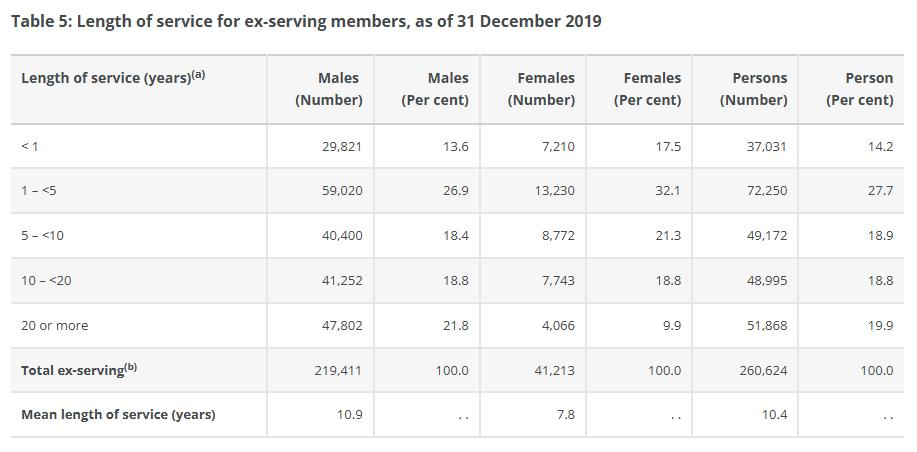
In an Australian Government 2019 report, ADF length of service is presented in five groups (ranging from less than 1 year to more than 20 years).   The average length of service was just over 10 years with more than one quarter (28%) having between 1 and 5 years of service, while 1 in 5 (20%) had served over 20 years.  So it’s statistically a bell curve peaking at around 10 year average – say approaching the age of 30 years, but the demographics vary.

Overall, 14% of ex-serving members had served less than 1 year. The proportion was slightly higher for females at 18% compared with males (14%) who had served less than 1 year.

Females generally had a shorter length of service with 1 in 10 (10%) having served over 20 years compared with more than 2 in 10 (22%) of males.

The average length of service was higher for males than females (11 years and 7.8 years respectively).
 

Source:   ‘Serving and ex-serving Australian Defence Force members who have served since 1985: population characteristics 2019‘ (report),  by Australian Institute of Health and Welfare, Australian Government,  11th August 2021, https://www.aihw.gov.au/reports/veterans/adf-members-population-characteristics-2019/contents/ex-serving-adf-members/length-of-service


* NOTE:    ADF “Separation” can be due to a range of different bases on an individual basis:

(A)   IMPS:  In General Enlistment, upon applying and then being accepted into the ADF, a commitment is required to stay with the service for a minimum period of time, called an Initial Minimum Period of Service (IMPS).  IMPS can be from 2 to 14.5 years depending on the role and service.  So separation would be somewhere during this period if desiring to then resign from the ADF;

(B)  Duration of Service: Voluntary separations are most common among those with less than 1 year of service (ADF 2019 statistics = 58%);

(C)  Voluntary Resignation: if enrolled as an officer cadet at Duntroon (which is voluntary), a cadet can resign at anytime, like on the same of arrival, if you quickly realised the place was a farce and wanted out. At ADFA, during Initial Training, cadets can resign at any time within the first two years (for Army/Air Force) or within the first year (for Navy) without having to serve a mandatory minimum period, as the IMPS usually becomes binding from the start of the second or third year of study;

(D)   Forced Resignation:  This was imposed in Julian Knight’s case.  His premediated means to protecting himself from relentless bastardiastion, assaults and battery from senior cadets by purchasing and carrying a personal flick knife off-campus and then his “premptive attack on his lead bully senior cadet at a Canberra Nightclub after midnight didn’t augur well for his graduation prospects from RMC Duntroon.  The RMC Brass basically forced him to resign as an Army Officer Cadet for that attack.  Rules for some.

(E)   AWOL:  Running away mid-course without ADF permission (akin to jumping the fence at anytime and then returning under 30 days, else then risk being ‘DESERTION‘ and subsequently deemed to be rated a ‘Dishonourable Discharge’.  Bastardisation, hazing and fagging can bring on such sentiments and Duntroon is particularly adept at such an assimilation regime.  However, propt voluntary return (not capture by the Military Police), can revoke that slur of Dishonourable Discharge to Honourable Discharge if due respectful protocols are then adhered to by the absconder such as returning and playing by the rules for a day or two to co-operated fulling in an official exit interview before the Brass and formal discharge process;

(F)   Retirement:  For the broader ADF, the compulsory retirement age is 60 for Regulars (permanent forces) and 65 for Reservists, assuming fitness and medical requirements are met;

(G)   Family/Lifestyle: Seeking stability, reducing time away from family, and wanting flexibility.

(H)   Disciplinary Action: Positive tests for prohibited substances or misconduct – eg: the 2013 Skype Scandal at ADFA.

(I)   On medical health grounds, including poor fitness.  This is an involuntary;

(J)   On mental health grounds.   A medical discharge on mental health grounds in the ADF occurs when a member is deemed permanently or long-term unfit for service, or for operational deployment, due to a psychological condition, psychological challenges, self-harm, et al.  (eg: fear of ISIS beheading – fair enough that).  This is an involuntary, administrative process driven by a Medical Employment Classification Review Board (MECRB) that can lead to rehabilitation, medical compensation, and potential re-enlistment if the member recovers;

(K)    Suicide.   Note that an extract of Key Findings by the Australian Government’s Institute of Health and Welfare on this ADF matter in brief state:

“The latest three-year suicide rate during 2021–2023 was 26.4 deaths per 100,000 per year for ex-serving males, 16.0 for permanent males, 15.2 for reserve males and 10.0 for ex-serving females.

The suicide rate for ex-serving males and females has generally declined since the mid-2010s, though this is based on preliminary deaths information and conclusive trends are subject to changes following finalisation of coronial processes. The suicide rate for permanent and reserve males shows no clear trend.

Serving permanent males and reserve males were less likely to die by suicide than the general Australian population. However, ex-serving males and females were more likely to die by suicide than the general Australian population.”

(L)    K.I.A. (In a box involuntarily, and not always in one piece or complete – think by enemy ‘I.E.D.’ );

(M)   M.I.A. (generally not voluntarily.   Else voluntary M.I.A. would by default be officially deemed AWOL – being to leaving for a short period without informing your chain of command.   AWOL then generally turns to serious DESERTION after 30 days absent.  In the old days, the military shot deserters by firing squad.);

(N)   Unknown  (always a good ‘out’ to finish on.  Thus allowing for ‘unknown unknowns’, such as an individual’s own particular circumstances which miss getting listed in the ADF ‘s  statistics (due to ADF embarassment) – like being bored, disaffected such by poor salary, not happy Jan with da conditions, negative leadership (shit boss), etc.  happens in Civvy life, eh?)


References and Further Reading:


https://www.aihw.gov.au/suicide-self-harm-monitoring/population-groups/adf-members

Next Post

CPL Ben Roberts-Smith, VC - cops woke retrospective kneejerk incarceration for historic SAS military service duty in the Afghan fog of war

The ‘Nine Entertainment’ franchise is all it is about, entertainment, gossip entertainment.  As for ‘journalism’ – what’s that? Sydney Channel 9 TV Presenter, Peter Overton, is just that – a presenter for tabloid Nine Entertainment.  And Nine’s got him well stuck into besmirching former Australian Army SAS Corporal Ben Roberts-Smith, VC. […]
error: Content is protected !!