
‘Length of service‘ is an official term across the Australian Defence Force (ADF) describing the duration (usually stated in number of full years) from the date a civilian individual joins the ADF (signing up on the dotted line) to the date of his/her eventual separation* from the ADF.
The ADF formal process upon an individual’s successful acceptance into the Australian Defence Force (ADF) arrives by official Registered Post with the acceptance notice and a formal notice to attend an ADF signing-in ceremony. It marks the end of the ADF recruitment phase and the official beginning of that individual’s ‘Military Service‘ – also being an ADF official term having a particular definition.
Typically, Day 1 of Military Service involves the civilian attending a pre-arranged appointment at an ADF barracks convenient to the applicant’s listed home address thence involving completing the final ADF contractual paperwork, a final and quick medical screening, participation at formal enlistment ceremony with other successful applicants, swearing an oath of allegiance to Australia’s Head of State, currently King Charles III, before being immediately transported under ADF supervision directly to your initial military training establishment – e.g. The Royal Military College Duntroon, which in Julian Knight’s case took place at Watsonia Army Signals Barracks (outer north-eastern Melbourne) on Monday 5th January 1987.
Oddly, the ADF continues to hark back to old British Army traditions in that General Entry applicants refer to this as Enlistment Day, whereas Officer Entry applicants refer to this as Appointment Day. However, to this author this represents a classist slur from a old world bygone era against Australian values of equality. On this day, one officially transitions from a civilian status to being a member of the ADF – aka Military Service.
So, the Average ADF ‘length of service’ time ?
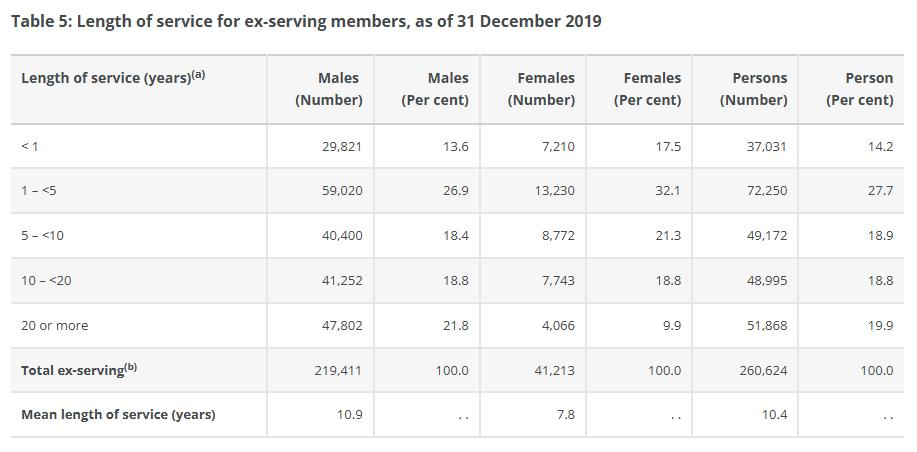
In an Australian Government 2019 report, ADF length of service is presented in five groups (ranging from less than 1 year to more than 20 years). The average length of service was just over 10 years with more than one quarter (28%) having between 1 and 5 years of service, while 1 in 5 (20%) had served over 20 years. So it’s statistically a bell curve peaking at around 10 year average – say approaching the age of 30 years, but the demographics vary.
Overall, 14% of ex-serving members had served less than 1 year. The proportion was slightly higher for females at 18% compared with males (14%) who had served less than 1 year.
Females generally had a shorter length of service with 1 in 10 (10%) having served over 20 years compared with more than 2 in 10 (22%) of males.
The average length of service was higher for males than females (11 years and 7.8 years respectively).
Source: ‘Serving and ex-serving Australian Defence Force members who have served since 1985: population characteristics 2019‘ (report), by Australian Institute of Health and Welfare, Australian Government, 11th August 2021, https://www.aihw.gov.au/reports/veterans/adf-members-population-characteristics-2019/contents/ex-serving-adf-members/length-of-service
https://www.aihw.gov.au/suicide-self-harm-monitoring/population-groups/adf-members